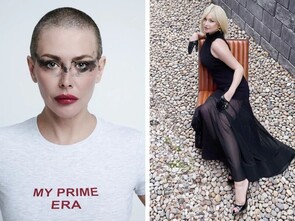
There's this photo from the March 2024 Vogue shoot. Miuccia Prada looks straight into the camera and basically tells you: fashion takes up a third of my life. The rest? Culture, Fondazione Prada, family, friends, some pleasures. Every morning she wakes up and decides — fifteen-year-old girl or woman on her deathbed. Try that. Seriously, try doing that before your coffee.
Then there's the word she keeps coming back to. "Useful." Not beautiful. Not luxurious. Useful. In an industry drowning in "gorgeous" and "chic," she picks the word that sounds like something you'd find in a kitchen drawer. And somehow that hits harder than any manifesto.
The girl who was never supposed to end up behind a sewing machine
1949. Miu Miu — before the brand stole her nickname. Political science. A doctorate. Five years of pantomime. Marching with communists. Fighting for women's rights. Then in 1978 she takes over Prada from her mother — a house her grandfather started in 1913 — and nobody, absolutely nobody, pictured this philosopher-politician running one of the biggest fashion empires on earth. But here we are. Since 1989, alongside Patrizio Bertelli, she's been quietly dismantling and rebuilding an entire industry's furniture.
"I would say that the Prada woman doesn't exist," she told Interview in 2012. "I'm interested in women in general. I have no preferences. I do what I think is right." Say that sentence out loud. In a field constructed on manufactured desire, she's essentially shrugging and saying: I design for people, not for characters in a mood board.
Ugly shoes, banana prints, and the art of making the absurd wearable
Whatever you think about Miuccia — and people have strong opinions — she has this almost unsettling gift. She looks at something that would make your aunt physically recoil and transforms it into the most wanted thing in the store. The waders. The ugly shoes. Banana prints on everything. She takes the thing you'd never post on Instagram and wraps it in enough intellectual scaffolding that buying it suddenly feels like an act of bravery.
"The word 'beautiful' is abused, just like 'luxury' or 'chic' in fashion circles," she's said. And she means it, dammit. For nearly fifty years she's been putting out collections that are self-referential and self-aware at the same time, clothes for people who think before they dress. The balancing act between conceptual and commercial doesn't just happen — it happens effortlessly. And that ease? That's the hardest trick in the entire book.
Resistance is not a trend
When Hugo Wherrett Marín photographed her, something shifted. "Resistance is a word I really like," Miuccia said. "What it means is very complicated." She talks about clothing as protest, then immediately pulls you somewhere deeper — into the architecture of thought itself. "Dress according to your thoughts," she says. "I always say: don't dress like a sex bomb to seduce a rich man unless that's how you feel. What has a lot to do with politics is your mind, not what you choose to wear."
Can a garment be political? She thinks so — but not in the way activists expect. "Any gesture can be political. Politics is much more than clothing." She's walked in protests wearing Saint Laurent. She's shown up to demonstrations in evening gowns. The point was never the costume. The point was the mind underneath it.
The uniform of a woman who refuses to think about getting dressed
Knee-length skirts — crumpled or pleated, doesn't matter. Crisp white T-shirts. Grey cardigans. Vintage jewelry. Coats worn instead of evening gowns. And then the shoes. Oh, those shoes. The fuzzy yellow Miu Miu slippers with oversized beads — a minor masterpiece of unapologetic weirdness, if you ask me.
The uniform, she explains, is freeing. It liberates you from the tyranny of choosing. You put it on and you're unburdened. Free. Unselfconscious. There's something almost monastic about a woman worth billions showing up in the same grey cardigan season after season — except that monasticism is, of course, the most stylish thing she could possibly do.
The woman who saw the future before it arrived
Here's where it gets eerie. Early 1990s. Prada starts making nylon backpacks. Luxury bags — from a house known for leather and heritage — out of waterproof, decidedly unglamorous industrial fabric. The New Yorker quoted her in 1990: "I want to mix the industrial way of doing business with the heritage of the past, with craft traditions." People laughed. Then they bought two. Now every house on the planet imitates the idea.
Today the Prada team is scrambling to produce those same iconic backpacks — along with a dozen other staples — from a more sustainable version of the material. The revolution continues, just greener.
Fondazione Prada: where fashion goes to stop being fashion
Bertelli shares her obsession with art, and their home reportedly houses a serious collection of paintings and objects. Fondazione Prada — the exhibition space that operates outside the gravitational pull of capitalism — has hosted personal shows by Laurie Anderson and Carsten Höller. "Fashion, art, culture, politics — it's all interconnected," Miuccia says. But she draws a line, sharp as a blade: she doesn't invite artists to design her collections. "I don't want people to think I'm using art to make my work more glamorous," she explains. "Maybe I'm the last professional moralist."
That line — the moralist who built a billion-dollar empire on nylon and banana prints — is maybe the most Miuccia sentence ever spoken. And it's perfect.
The Annie Leibovitz frame
March 1997. Annie Leibovitz shoots her for American Vogue and the image still stings with clarity: "What you wear is how you present yourself to the world, especially today when human contacts are so quick. Fashion is the instant messaging of life."
Seventy-seven years old. Doctorate in political science. Five years of pantomime. A house she inherited from her mother. A partner she built an empire with. A foundation that exists in defiance of commercial logic. And every single morning, a coin flip between a teenager and a dying woman.
Happy birthday, Miuccia. The industry doesn't deserve you. But it can't function without you.