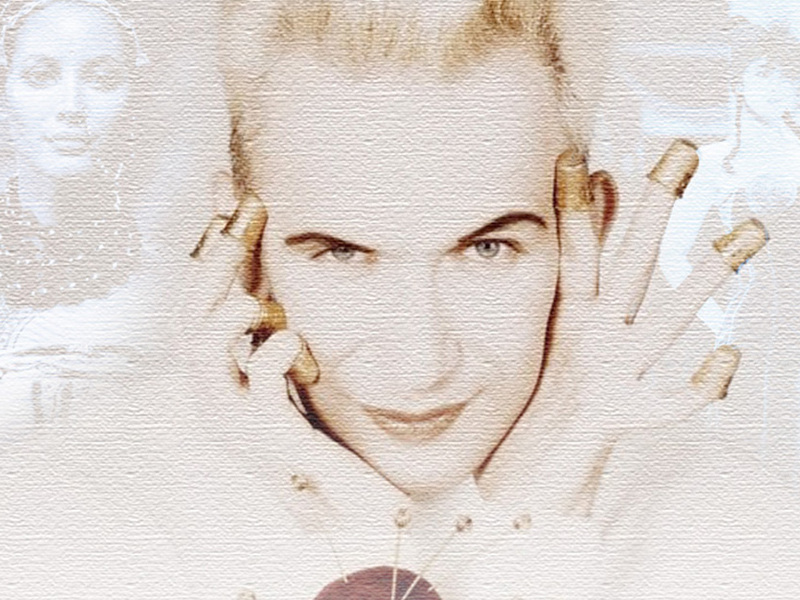
Jean-Paul Gaultier turns 74 this week—hard to believe, right? The man once branded fashion’s enfant terrible isn’t scrambling to one-up his own outlandish stunts anymore. No, he’s got a rare kind of ease now, the kind that comes when you’ve built something that outlasts you. His eponymous house has been in Durand Lantink’s steady grip for a full year, and that’s no small thing. Pierre Cardin once said his work was recognizable without even glancing at the label—how many designers can claim that? Gone are the frantic days of chasing the next shock. What’s left is quiet, unshakable pride.
Back in 1976, the guy was fresh-faced but already weathered by stints at Pierre Cardin, Jacques Esterel, Jean Patou—standard apprenticeship stuff, but he’d clearly had enough. His first independent collection with partner Francis Menouge? Less a clothing line, more a raised middle finger to every sartorial rule in Paris. The debut show didn’t get applause, it got outrage. Good. That’s exactly what he wanted. He wasn’t building a brand to sell trivial seasonal collections, he was turning fashion into a battleground for identity. Commerce could wait. Why should clothes just be things you put on? They’re supposed to say who you are, right?
His most lasting nautical code? The Breton stripe, obviously. What started as stodgy navy-and-white cotton tees and tights turned into a second skin. Psychedelic iterations, warped proportions, fabrics that clung to curves or twisted them entirely out of shape. He didn’t frame the sailor as some wholesome patriot, no—this was an anti-hero. Hyper-masculine, vulnerable, dripping with subtext you couldn’t ignore. Fishnet tight enough to snag a herring, lace-up knits that felt like equal parts discipline and desire. Uniform that refused to stay uniform. Who ever said a sailor’s tee had to be boring?
A decade after that nautical debut, he pulled fragrance into his messy, disruptive orbit. Classique, his first women’s scent, hit shelves in a corseted torso flask—no delicate glass bottle here, this was a statement. Notes of rum-soaked rose, vanilla, ginger? It rejected every “good girl” perfume trope of the 80s. The heroine wasn’t polite, she was unapologetic. Then Le Male dropped in 1995, a testosterone-laced mix of lavender, mint, vanilla stuck in a rippling male torso wearing a striped tee. It flew off shelves globally, especially in Latin America and Southern Europe. He’d turned “hyper-masculinity turned inside out” into a 20th-century icon. And he was the first designer to treat packaging as part of the concept, not an afterthought—metal tins instead of flimsy cardboard, flasks shaped like sculptures. Later flankers like Scandal, La Belle, Le Beau doubled down on his obsession with bodies and theater. No subtle scents here. Only statements you could smell from three rooms away.
Spring/summer 1985’s Et Dieu créa l'homme (“And God Created Man”) broke binary rules like nobody’s business. He didn’t use kilts or samurai robes as cultural costumes, no—he put men in skirts as everyday wear. Some models played it safe with trousers with wide plaid wraps, but the skirt was the star. A full-fledged garment for men, no explanation needed. He kept coming back to it: David Beckham’s printed sarong in the late 90s, the kilts he wore himself, the sarongs on Ricky Martin, Marc Jacobs, even Brad Pitt in his 1999 Rolling Stone shoot. This wasn’t shock for shock’s sake. It was an alternative. He chipped away at gendered clothing norms bit by bit, like that spring/summer 1993 collection where women wore high-waisted suit trousers with suspenders that doubled as breast coverage. Who decides which body wears which silhouette, anyway? Why do we even have those rules?
Gaultier’s bare skin moments never veered into cheap erotica. Never. For him, a sheer panel or cut-out was a cultural, political, artistic gesture. Whose gaze holds power—the model’s or the viewer’s? Why is a man’s bare chest fine, but a woman’s a scandal? Those questions were stitched into every design. September 2, 1992: he took a bow at an amFAR fundraiser with Madonna, both in jumpsuits with chest cut-outs. Nearly a decade later, spring/summer 2002 had Naomi Campbell walking the runway covering her bare chest with her own hands, Carla Bruni in a gown with a back so deep it almost brushed scandal. He blurred the line between flesh and garment, then erased it entirely. When does a body stop being a body and start being a statement? That’s the question he wanted you to ask.
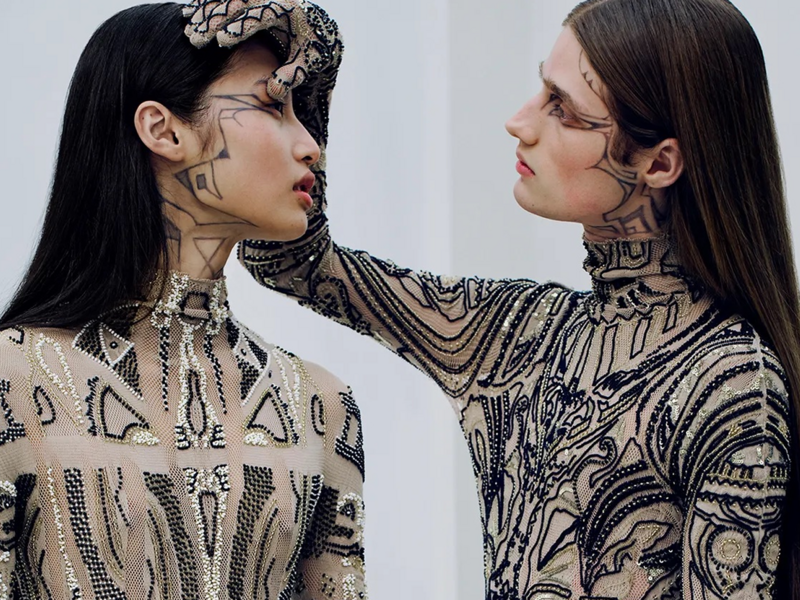
Spring/summer 1994’s Tatouage collection turned clothing into living skin. Sheer tops, leggings, dresses printed with fake tattoos: tribal motifs, Japanese dragons, Slavic ornaments, old-school anchors, indigenous body art riffs. Most sat under translucent mesh, so realistic you’d do a double take to check if the model actually inked their thigh. He wasn’t romanticizing subcultures, no. He was turning skin into narrative. Stamping signs of identity, traces of life, unshakable marks onto fabric. Clothing is just a second skin we choose, right? As Orsola de Castro once said. He kept coming back to the motif in couture lines, costumes for Paris cabaret Crazy Horse, even collections from Maison Margiela, Acne Studios, Marine Serre. His own Tattoo capsule last year proved the idea still sticks: ink fades, but the story stays. That’s the point.
You know the silhouette instantly. Pointed, architectural, defiant. The conical bra first popped up in his 1983 collection, but it blew up globally in 1990 when Madonna wore it on her Blond Ambition Tour. It pulled lingerie aesthetics into pop culture’s mainstream, cementing itself as a symbol of new femininity: aggressive, in control, sexual, unapologetic. The design nods to 40s and 50s lingerie shapes, but Gaultier stripped away all the romance. No soft curves here. Only sharp cones, structural form that feels like armor, a parody of traditional femininity. He’d joke that the first iteration was way more naive: at six years old, he made a corset out of newspaper and string for his teddy bear Nana. Who knew a kid’s craft project would become one of fashion’s most recognizable symbols? Wild.
1997 was his first big dive into film costume design, for Luc Besson’s sci-fi blockbuster The Fifth Element. Over 900 costumes for the project: futuristic corsets, plastic armor, asymmetrical slits, bandages, bare skin, hypertrophied shapes—all his signature codes, reimagined for a galaxy far from Paris runways. The standout? Milla Jovovich’s Leeloo, in a minimalist white suit made of plastic strips that bared skin while doubling as armor. Erotic fantasy and battle-ready uniform all at once. Tattoos, lingerie structures, uniform nods—this wasn’t “future fashion” as much as a gaze from the future back at 90s sexuality, hierarchy, corporeality. Even in space, his codes travel. No escaping them.
His engagement with religion is still one of his most polarizing moves. Autumn/winter 1993, unofficially dubbed “Rabbis Chic” by the press: models in Hasidic-inspired looks, long black coats, fedora hats, payot, men’s suits tailored for female frames. Spring/summer 1998 leaned into Christian iconography: dresses with crucifixes, halos, nods to Renaissance Madonna paintings. Tulle, guipure, velvet gowns framed holy symbols while baring breasts, hips, stomachs. That same collection pulled from Frida Kahlo too. A second wave hit in 2007’s Tribute to Religion, pulling from Buddhist robes, Catholic nun habits, Indian saris, Eastern priestess garb—a cosmopolitan pantheon of sorts. Critics split: brave cultural collage, or aestheticizing the sacred for shock? Gaultier never cared for consensus. Never. He did what he wanted.
1997 haute couture collection Les Amazones dove into op-art and geometric experimentation. Prints inspired by Hungarian op-art father Victor Vasarely created hypnotic patterns on fabric that stretched silhouettes, bent proportions, played with perception. Continuation of the Tatouage theme, but layered with optical illusion. He leaned hard into trompe-l’œil too: painting corsets, suspenders, even bare skin onto dresses, knits, tops. A 1984 body print with faux muscles was an early example, a DNA strand guest designers still pull from for couture collections today. Why wear a corset when you can paint one on? Why show skin when you can trick the eye into seeing it? His illusions weren’t cheap tricks. They were questions about what’s real and what’s constructed. That’s the difference between a gimmick and art.
Autumn/winter 2011 men’s collection turned the runway into a boxing ring, models into fighters. But these weren’t macho men. They tripped, blushed, flexed muscles that looked glued on, sported theatrical bruises instead of real ones. Boxer briefs worn over trousers with padded crotches drove home the point: masculinity here was a costume, not a given. Reactions split. Some loved the theater, others recoiled at the over-the-top masculinity. That was the point. He wasn’t presenting a “correct” man. He was showing that masculinity, like every other identity, is a mask we put on. What happens when you strip away the performance? What’s left underneath?
When Gaultier announced his retirement from haute couture in 2020, it wasn’t a goodbye. It was a revolution. Instead of shuttering the brand, he launched an unprecedented format: each couture season designed by a guest creator. First Sacai’s Chitose Abe, then Glenn Martens (Y/Project, Diesel), Balmain’s Olivier Rousteing, Paco Rabanne’s Julien Dossena, Simone Rocha, Courrèges’ Nicolas de Felice, Ludovic de Saint Sernin. Each brought their own codes, reworking Gaultier’s archetypes: corsets, tattoos, uniform, gender ambivalence. Ackermann did a poetic, minimalist take; Rocha leaned into Victorian femininity and distorted innocence; de Saint Sernin centered nautical motifs. No designer of his stature had ever turned their brand into an open stage before. As of 2025, the guest designer era is closed, Durand Lantink leads full-time, interpreting Gaultier’s codes season after season. The legacy lives on. Not bad for a kid who made newspaper corsets for a teddy bear.