Presence and Transition: The Art of Vladimir Kuprinyanov
Picture this: a man with a camera, sneaking into the Kyivska metro like some urban Indiana Jones. Vladimir Kuprinyanov wasn't just snapping pictures—he was orchestrating a collision between Soviet pomp and the quiet chaos of everyday life. His "Kyivska" series? It's like opening a time capsule that refuses to stay sealed. The layering, the framing—it's not just technique, it's alchemy. Archival footage becomes something alive, breathing, whispering secrets. And let's be honest, shooting in a strategic object back then? That took guts. Not everyone had the nerve to point a lens where independent voices were rarely heard.
The Intimacy of Everyday Life: Nikki Zimov's Summer Diary 4
Nikki Zimov doesn't just make art—he weaves it, stitches it, paints it, and then somehow makes it sing. Summer Diary 4 is a masterclass in texture: oil paints and acrylic powder dancing together like old friends at a reunion. The result? A surface so rich you almost want to touch it. But don't. This isn't just about aesthetics; it's about intimacy. Each brushstroke feels like a page torn from a diary you weren't meant to read. And yet, here you are, invited to linger. Art&Brut knows how to spot talent—artists who can make the mundane glow without asking you to sacrifice a thing.
The Liminal Spaces of Alexandra Gart
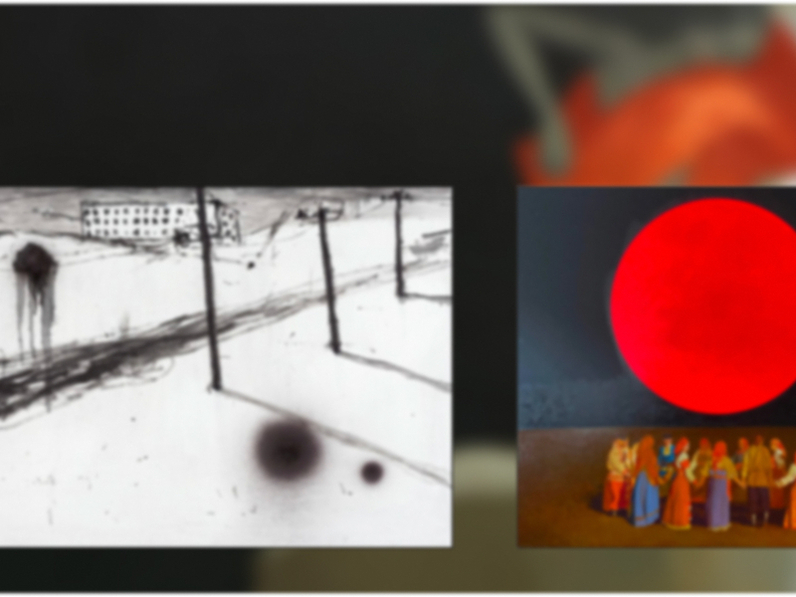
Alexandra Gart doesn't do comfort zones. In "Two Ball Lightning," she drags you to the edge—literally. Her liminal spaces are where civilization crumbles and wild landscapes take over. It's not pretty. It's not safe. But it's real. Nature here isn't a postcard; it's a warning. The "non-human agents" and ruins? They're not just props. They're the stars of the show. Gart forces you to stare into the void and ask: what's hiding in the gaps between nature and culture, past and present? Spoiler: it's not always what you expect.
The Existential Quest of Mikhail Dobrovolsky
Mikhail Dobrovolsky walks into a gallery with no formal art education and says, "Watch this." His architectural background might explain the precision, but it's his freedom that makes the work sing. In the "H.L.A.M." exposition, he doesn't just critique society—he throws a Molotov cocktail at it. Total consumption, super-speed, the whole circus. His art doesn't ask for permission; it demands attention. And in a world obsessed with competition, his existential quest feels like a breath of fresh air—or maybe a slap in the face. Either way, it lands.
The Transitional Forms of Oleg Ivashchenko
Oleg Ivashchenko is the kind of artist who makes you question everything—starting with the word "transitional." As a corresponding member of the Russian Academy of Arts, he could rest on his laurels. Instead, he uses his impeccable technique to capture the fleeting, the unstable, the almost-gone. In "Escape," he dissects tradition like a surgeon, turning ruins into something necessary, even vital. The result? Art that's both tangible and elusive, like trying to hold smoke in your hands. It's a balancing act, and Ivashchenko? He's walking the tightrope like it's nothing.
The Surreal Reality of Kirill Saveliev
Kirill Saveliev takes Voronezh—yes, *Voronezh*—and turns it into a dreamscape. His photographs are like snapshots from a parallel universe where the ordinary becomes extraordinary. At the "Jessica" gallery, his work is part of a larger exploration of mental borders and the fragility of normality. He doesn't just document reality; he rewrites it. Suddenly, a fence or a window isn't just a fence or a window—it's a portal. And you? You're left wondering if your own ideas about authenticity are as solid as you thought.
The Sentimental Value of Daniil Deghe
Daniil Deghe's work is a love letter to the everyday, written in distorted perspectives and saturated colors. His painting doesn't just depict routine—it elevates it. That dog in the workshop? It's not just a dog. It's a symbol, a reminder that beauty often hides in the smallest, most personal moments. For Deghe, sentimentality isn't a weakness; it's a strength. And in a world obsessed with metrics and value, his art is a quiet rebellion. It says: sometimes, the most priceless things can't be measured.
The Cinematic Vision of Leonid Rotar
Leonid Rotar doesn't just paint—he directs. With a background from VGIK, he brings the drama of cinema to the canvas. "Round Dance" is a whirlwind of movement and light, a dance between the archaic and the modern. It's not just a painting; it's a story, a moment frozen in time but bursting with life. Rotar's work is a reminder that art doesn't have to choose between tradition and innovation—it can be both, and then some.
The Pareidolia of Elena Filaretova
Elena Filaretova plays with your brain like it's a toy. Her work is built on pareidolia—the mind's tendency to see faces in abstract shapes. In "Portrait," she gives you just enough to start, then lets your imagination take over. The transparent oil paints create a flickering effect, as if the image is alive and trying to escape. Every viewer sees something different, and that's the point. Filaretova doesn't just create art; she creates a conversation between the work and the viewer. It's interactive, intimate, and a little bit magical.
The Meditative Presence of Viktor Alimpiev
Viktor Alimpiev doesn't just make art—he creates sanctuaries. At the "Tirazh 1/1" booth, he transforms the chaos of a fair into a space of stillness. "Nobody but the Stars" is a moment of vulnerability, a call to silence and concentration. In a world that never stops talking, Alimpiev's work is a rare gift: the chance to breathe, to be present, to reflect. It's not just art; it's an experience. And in a noisy world, that's something worth holding onto.